Yanran Jiang1, Cécile Paris1, Dana Kulić1,2, and Leimin Tian1
1CSIRO Technology, Australia 2Monash University, Australia
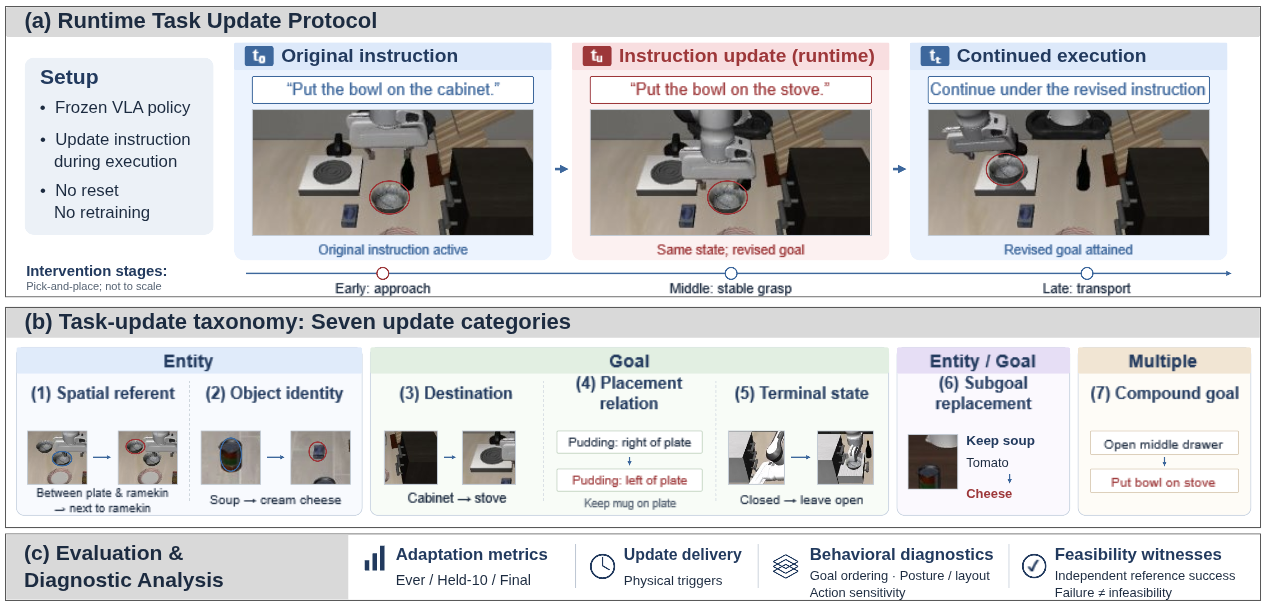
The robot is reaching for a bowl when its destination changes. The instruction switches from cabinet to stove, and the rollout continues from the physical state the robot has already reached.
Can a robot revise a task it has already started? DTU-Bench pairs original and updated language instructions in the same LIBERO scene. Across 40 task revisions and 13 vision-language-action policy configurations, it measures whether the robot reaches the new goal, how it gets there, and whether the goal still holds at the end.
Abstract
Vision-language-action (VLA) policies perform well on fixed-instruction robotic manipulation benchmarks, but their ability to adapt to instruction changes during execution remains understudied. We introduce the Dynamic Task Update Benchmark (DTU-Bench), evaluating 40 task revisions across seven update types and three execution stages using LIBERO, a simulated robotic manipulation benchmark. We compare performance when a new instruction is given before execution starts versus during execution, and examine whether the new task instructions are followed. Across 13 representative VLA configurations, average task success is 95.8% on the original object-manipulation tasks, compared with only 1.6% when the instruction changes which object to manipulate during execution. Controlled diagnostics show that policies often complete the original task before the updated one, and that their responses depend on the robot's physical state. We further test whether a simple scripted controller that releases the grasped object and moves the arm back helps robots respond to instruction changes. This improves success from 2% to 38% for π0.5 and from 8% to 48% for DM0.5, but can cause unwanted object motion. These findings reveal limitations that fixed-instruction benchmarks and task-success metrics alone can overlook in evaluating robotic manipulation.
Key Findings
Overall benchmark results
Thirteen policy configurations execute the original task from the start and receive task updates during execution. In each cell below, the first value scores the original goal at the end of its control episode. The blue value scores the updated goal at the end of a runtime episode, pooling early, middle, and late updates. The two values score different goals.
Scroll the table horizontally to see all seven categories.
Table 3 · Final success (%) by policy configuration and update category
Configuration
Spatial referent
Object identity
Destination
Placement relation
Terminal state
Subgoal replacement
Compound goal
OpenVLA
81.2 → 0.0
85.4 → 0.0
76.8 → 36.4
24.2 → 1.8
34.0 → 5.6
63.5 → 0.0
67.2 → 6.8
OpenVLA-OFT
96.4 → 0.0
98.0 → 0.0
92.8 → 45.3
55.3 → 0.0
85.3 → 3.1
90.5 → 0.0
90.0 → 0.9
π0.5
95.8 → 0.0
98.0 → 0.7
94.4 → 68.8
50.3 → 0.0
74.7 → 0.7
96.0 → 0.2
90.8 → 5.3
DM0.5
98.4 → 0.1
99.8 → 13.5
95.6 → 57.2
39.6 → 1.1
90.0 → 0.2
98.0 → 0.2
92.0 → 17.5
π0
94.4 → 0.5
97.6 → 0.0
84.8 → 57.1
59.7 → 0.0
62.0 → 1.3
70.5 → 0.0
89.6 → 18.9
RynnVLA-002 cont.
90.2 → 0.0
94.8 → 0.1
91.6 → 42.8
61.3 → 0.0
76.0 → 0.7
94.5 → 0.0
78.0 → 2.3
VLA-JEPA
96.4 → 0.0
99.8 → 0.0
98.0 → 57.3
89.9 → 0.0
82.7 → 0.4
97.5 → 0.0
92.0 → 15.6
InstructVLA stage-1
94.6 → 0.0
99.2 → 0.1
97.6 → 53.5
70.5 → 0.0
80.0 → 1.6
88.5 → 0.0
91.2 → 2.7
τ0-VLA low-level
97.0 → 0.1
99.2 → 0.1
95.6 → 54.0
43.0 → 0.0
90.7 → 0.0
89.5 → 0.0
87.6 → 7.9
MolmoAct2 cont.
97.0 → 0.1
99.0 → 4.9
97.2 → 58.1
47.7 → 1.6
74.7 → 0.9
95.0 → 0.0
92.8 → 19.5
FlashVLA-π0.5 sync.
97.2 → 0.3
99.0 → 1.3
94.0 → 57.6
59.7 → 0.0
83.3 → 0.0
98.0 → 1.7
91.6 → 18.9
WorldVLA
69.6 → 1.2
79.0 → 0.6
78.4 → 38.6
28.7 → 0.0
30.7 → 1.1
44.5 → 0.0
67.6 → 3.9
UniVLA
98.0 → 0.0
96.0 → 0.0
60.0 → 46.7
66.7 → 0.0
73.3 → 2.2
85.0 → 0.0
84.0 → 5.3
For updated-from-start controls, Held-10 scores, and denominators, see the full benchmark results.
Finding 1. Not All Task Updates Are Equally Difficult
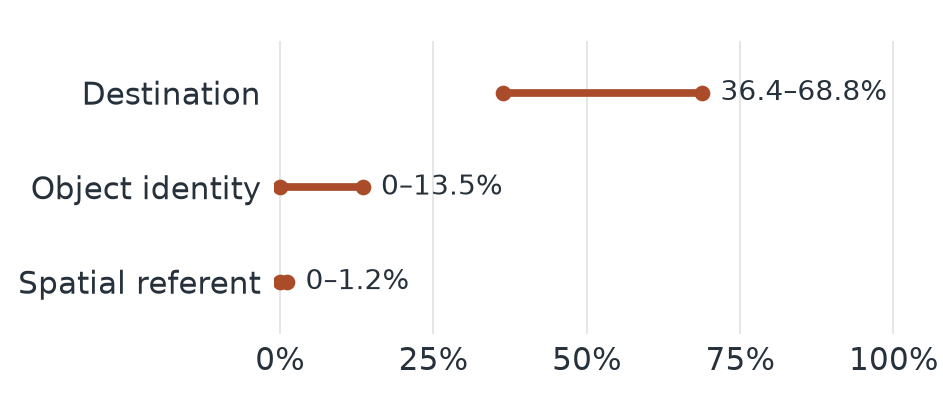
Changing the destination is often easier than selecting another object.
Across the evaluated configurations, destination updates yield 36.4–68.8% runtime Final success. Object-identity updates reach at most 13.5%, and spatial-referent updates at most 1.2%. Each interval runs from the lowest to the highest observed policy rate.
Range of runtime Final success across the 13 configurations in Table 3. All three categories share the same percentage scale.
Key insight A destination change can preserve a useful grasp. Scene layout and manipulation difficulty also vary across categories, so these differences alone cannot isolate the effect of the update type.
Finding 2. Task Competence Does Not Imply Runtime Adaptability
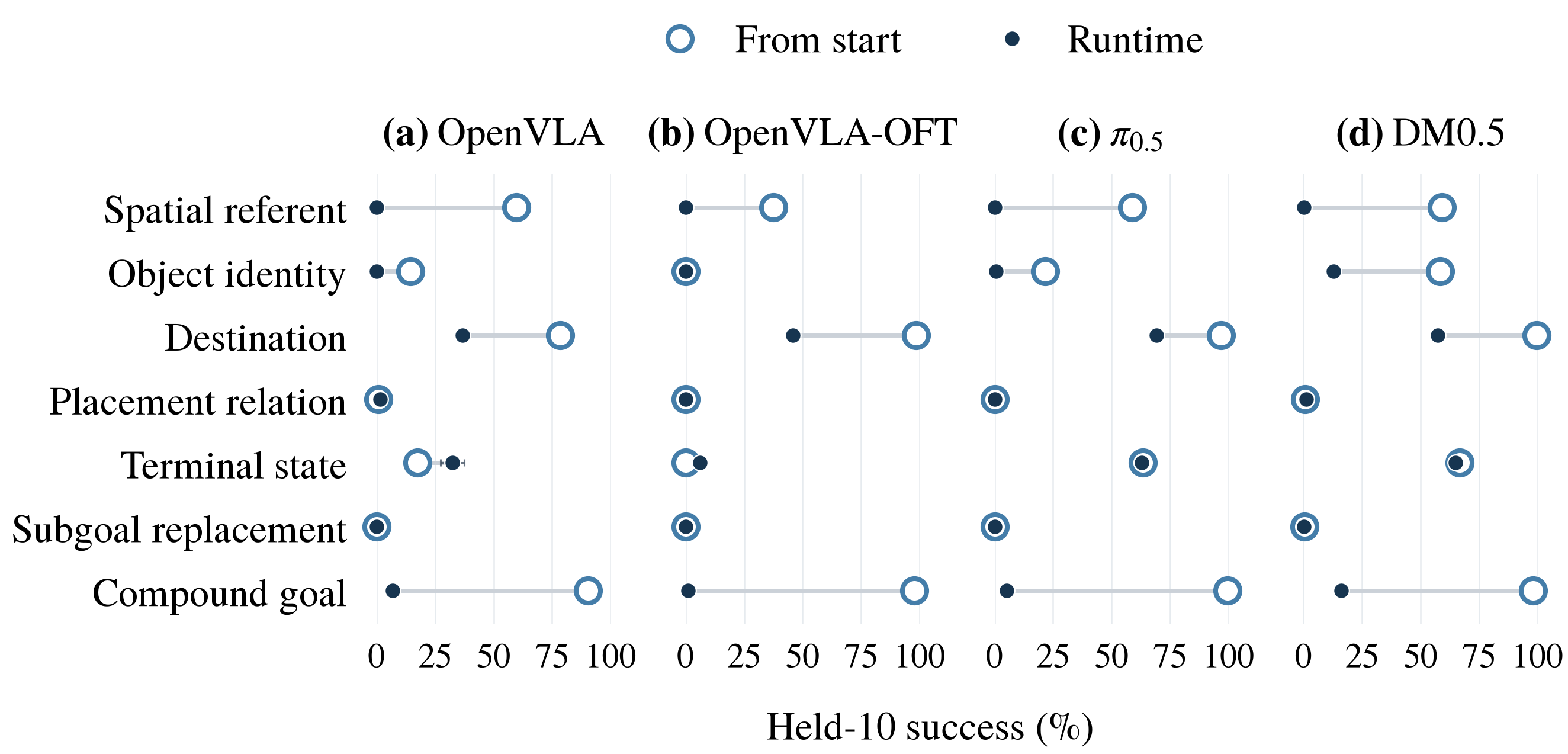
The same instruction can succeed from the start and fail after the robot has begun another task.
On compound goals, OpenVLA-OFT sustained the updated goal for ten consecutive observations in 244/250 updated-from-start trials (97.6%), compared with 7/750 valid scheduled runtime trials (0.9%). The paired gap is 96.7 percentage points. Both conditions score the same updated goal.
Figure 2 · Open markers show updated-from-start Held-10. Filled markers show runtime Held-10. Each connecting line compares the same policy and update category.
π₀, LIBERO-GOAL. Both runs use the same initial scene. With the wine-bottle instruction from the start, the robot places the bottle on the cabinet. With the same instruction delivered during approach to the bowl, it places the bowl instead. Left and right are aligned to instruction delivery.
Key insight Giving the revised instruction from the start tests whether the policy can perform the task. Delivering it during execution tests whether the policy can redirect behavior from a state reached under the old task.
Finding 3. Later Task Updates Are Not Always Harder
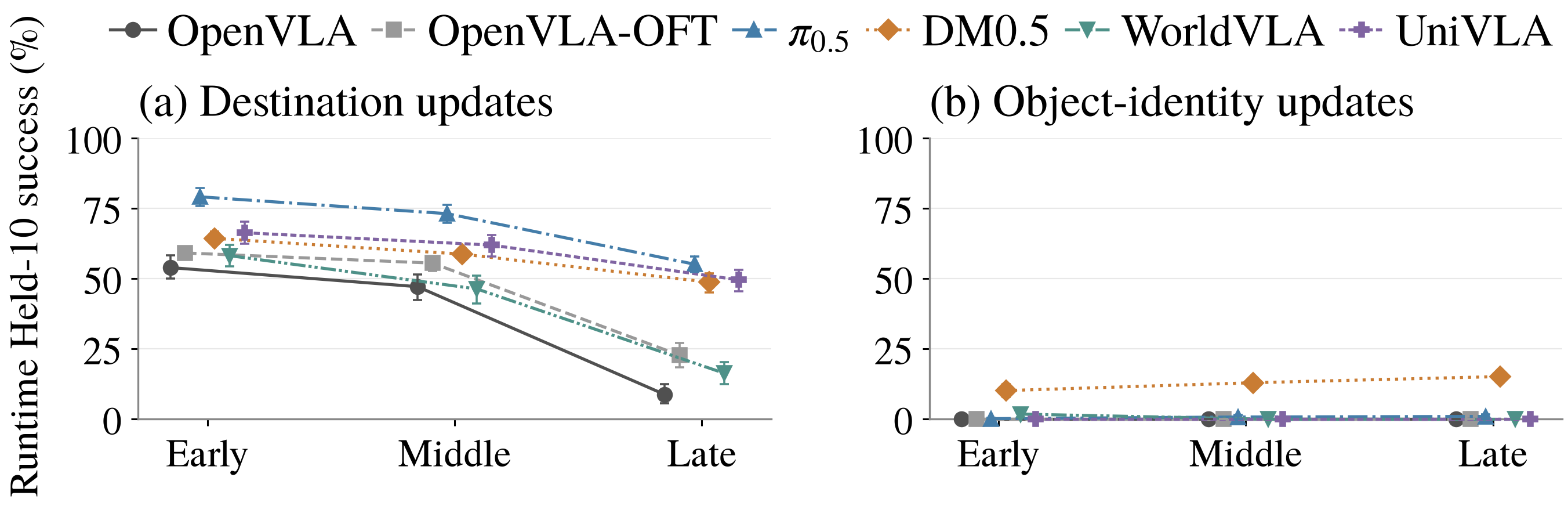
The direction of the timing effect changes with the task.
For DM0.5, destination Held-10 success falls from 64.4% to 58.8% to 48.8% across early, middle, and late updates. Object-identity success rises from 10.2% to 13.0% to 15.2% in the same stage order. Each destination stage has 250 valid scheduled trials and each object stage has 500.
Figure 3 · Runtime Held-10 by intervention stage. The denominator includes valid scheduled trials whose update event was never reached. Whiskers show 95% confidence intervals.
Key insight Interpret timing relative to what remains useful from the original task. An early, middle, or late update represents a physical event in that task.
Finding 4. Goal Attainment Can Mask Adaptation Failures
A success score hides both the path to the new goal and what happens next.
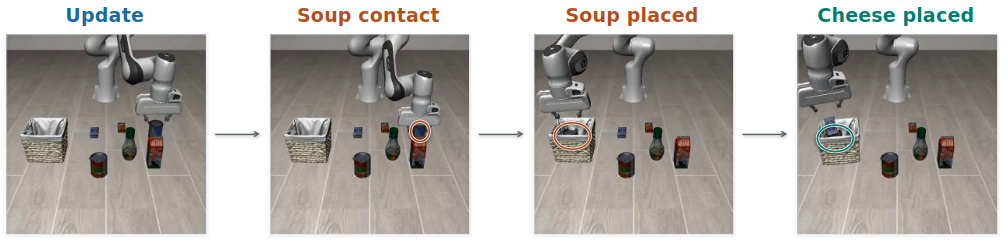
Delayed response. Among 192 delivered DM0.5 object updates that achieved updated Held-10, 184 reached the original goal first. The recorded sequence below shows the robot receiving a cream-cheese instruction, placing the alphabet soup, and only then placing the cheese.
Figure 6 · LIBERO-Object. The original goal is to put the soup in the basket. The update changes the requested object to cream cheese.
Incidental attainment
In 37 of 94 matched pairs, both the original-instruction and updated-instruction branches achieved updated Held-10. All 37 involved terminal-state updates. Following the old instruction could briefly satisfy the new predicate.
Temporary satisfaction
For DM0.5 terminal-state updates, 64.9% achieved Held-10 but only 0.22% still met the goal at Final. A drawer can remain open for ten observations and then close.
Key insight Ever records a single attainment, Held-10 records a sustained interval, and Final tests the last observation. The trajectory reveals whether the robot switched promptly.
Finding 5. Prior Progress and Robot State Shape Task Adaptation
The same words and object layout can lead to different first contacts.
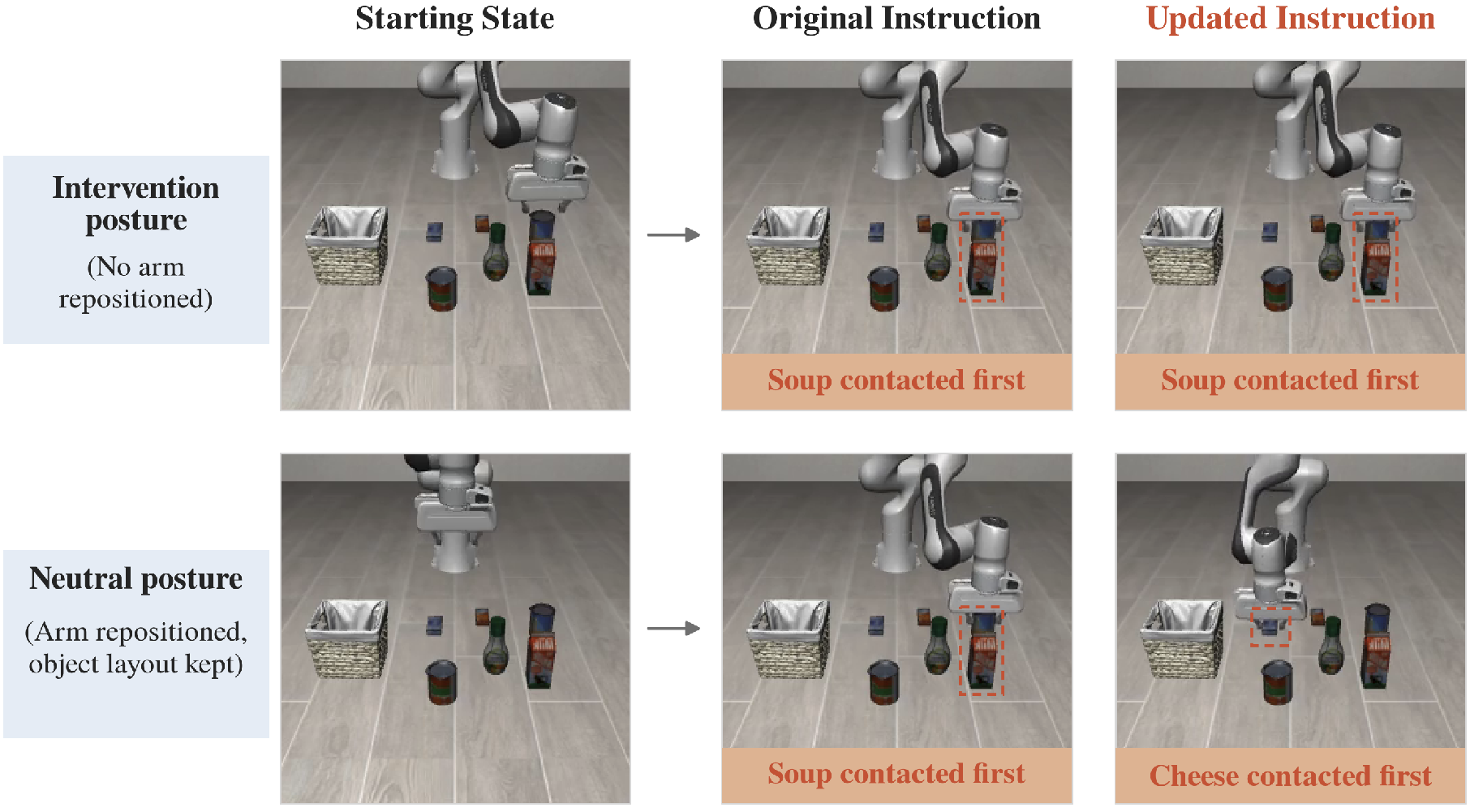
In the controlled DM0.5 object-selection experiment, the first contact matched the instruction in 20/40 saved-posture continuations and 40/40 neutral-posture continuations. The design varied instruction, layout, and posture across two object tasks. The two rows below hold the object layout fixed.
Figure 5 · Read the right column vertically. Both rows request cream cheese. The red boxes identify the first object contacted; the neutral condition repositions the arm before continuation.
When earlier progress helps
In a separate matched-stage probe, π0 and π0.5 each succeeded in all 10 destination-update continuations. After stable grasp, neither completed the object switch in five attempts per policy, although the updated-from-start controls succeeded.
Key insight Physical configuration can influence object selection. First contact is only one step toward completing the revised task, and these controlled cases explain a subset of failures.
Finding 6. Physical Assistance Can Mitigate Some Adaptation Failures
A fixed-joint retreat helps before grasping. After grasping, releasing the object changes the outcome.
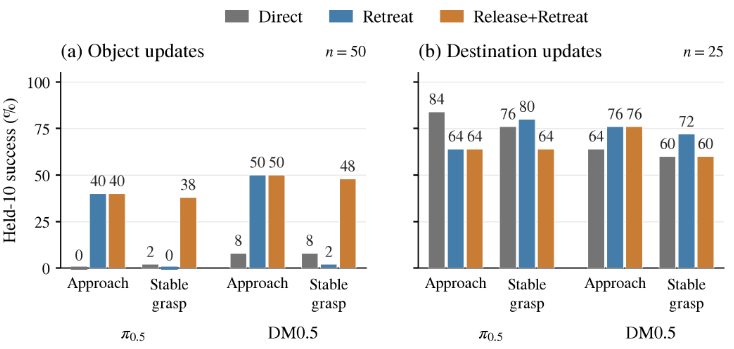
In DM0.5 approach-stage object updates, 4/50 direct trials achieved Held-10, compared with 25/50 after fixed-joint retreat. At stable grasp the counts were 4/50 direct, 1/50 retreat, and 24/50 release-and-retreat. Helper actions used part of the same 300-action budget.
Figure 7 · Direct passes the updated instruction immediately. Retreat returns the arm toward its initial joint pose. Release-and-retreat opens the gripper first. Rates use 50 scheduled trials per object condition and 25 per destination condition.
Matched example: release before retreat
π₀.₅, LIBERO-Object, stable grasp. Both branches start with the gripper around the soup. The direct branch places the soup; release-and-retreat lets the policy place the newly requested cream cheese. Both branches have 300 actions, including helper motion.
Costs of intervention
For π0.5 destination updates at approach, retreat reduced Held-10 from 21/25 to 16/25. At stable grasp, release-and-retreat produced unsupported downward object motion in 49/50 object trials for each of the two policies.
Key insight Physical assistance can recover some object switches without retraining. Its value depends on whether prior progress should be preserved and on the physical consequences of releasing the object.
DTU-Bench uses the four LIBERO suites: Spatial, Object, GOAL, and Long. Each of the 40 source tasks has one registered revision. The examples summarize the paired instructions in Supplementary Table S3.
Update type
Suite
Tasks
Original instruction
Updated instruction
Spatial referent
Spatial
10
Place the bowl between the plate and ramekin on the plate.
Select the bowl next to the ramekin for the same placement.
Object identity
Object
10
Put alphabet soup in the basket.
Put cream cheese in the basket.
Destination
GOAL
5
Put the bowl on the cabinet.
Put the bowl on the stove.
Placement relation
Long
3
Place the pudding to the right of the plate.
Keep the mug placement and put the pudding to the left.
Terminal state
Long
3
Put the black bowl in the drawer and close it.
Put it in the drawer and leave the drawer open.
Subgoal replacement
Long
4
Put alphabet soup and tomato sauce in the basket.
Keep the soup and replace tomato sauce with cream cheese.
Compound goal
GOAL
5
Open the middle drawer.
Put the bowl on the stove.
When does the instruction change?
Each task starts from 50 official initial states. Original-from-start and updated-from-start controls establish performance on the two instructions independently. Three runtime conditions deliver the update at task-specific physical events. For pick-and-place tasks, these are approach, stable grasp, and transport. At delivery the evaluator discards queued actions, requests fresh inference, and allows 300 executed actions from the reached state.
The goal holds after at least one executed action.
Held-10
The goal holds for ten consecutive executed-action observations.
Final
The goal holds at the last evaluated observation.
Full benchmark results
How often does the updated goal hold? Explore original, updated-from-start, and runtime performance for each of the 13 evaluated configurations. The complete 50-state results below use Supplementary Table S7.
Supplementary Table S7 · F50
Success by update type
DM0.5 · Final
Success rates for each of seven update types
Update type
Original
Updated from start
Runtime
Spatial referent
98.4%492 / 500
58.2%291 / 500
0.1%1 / 1500
Object identity
99.8%499 / 500
58.4%292 / 500
13.5%202 / 1500
Destination
95.6%239 / 250
94.8%237 / 250
57.2%429 / 750
Placement relation
39.6%59 / 149
0.7%1 / 149
1.1%5 / 447
Terminal state
90.0%135 / 150
0.0%0 / 150
0.2%1 / 450
Subgoal replacement
98.0%196 / 200
0.5%1 / 200
0.2%1 / 600
Compound goal
92.0%230 / 250
98.0%245 / 250
17.5%131 / 750
Each cell gives the success rate and successes / valid trials. Runtime denominators include valid trials whose update event was never reached. Invalid records are excluded. F50 uses 50 initial states per task.
OpenVLA-OFT starts with the instruction to put a bowl on the cabinet. Starting from the same initial scene, the robot succeeds when the stove update arrives during approach or stable grasp. In the transport-stage episode, the update is delivered but the bowl never reaches the stove. Watch all three continuations aligned at delivery.
Runtime updates by category
Follow the original instruction, the point of delivery, and the robot’s continuation. These individual episodes illustrate different outcomes; the performance estimates appear in the benchmark tables.
Destination
DM0.5 · LIBERO-GOAL · early runtime update
Original. Put the bowl on top of the cabinet. Update. Put the same bowl on the stove.
Outcome. The updated goal met Held-10 and held at the final observation.
Object identity
π0.5 · LIBERO-Object · middle runtime update
Original. Place the salad dressing in the basket. Update. Place the alphabet soup in the basket.
Outcome. The updated goal met neither Held-10 nor Final.
Spatial referent
π0.5 · LIBERO-Spatial · middle runtime update
Original. Put the black bowl on the cookie box onto the plate. Update. Put the black bowl on the wooden cabinet onto the plate.
Outcome. The updated goal met neither Held-10 nor Final.
Placement relation
π0.5 · LIBERO-Long · middle runtime update
Original. Put the white mug on the left plate and the yellow-and-white mug on the right. Update. Swap the plate destinations of the two mugs.
Outcome. The updated goal met neither Held-10 nor Final.
Terminal state
DM0.5 · LIBERO-Long · late runtime update
Original. Put the black bowl in the bottom drawer and close it. Update. Put the bowl in the bottom drawer and leave it open.
Outcome. The updated goal met Held-10 but no longer held at the final observation.
Subgoal replacement
DM0.5 · LIBERO-Long · middle runtime update
Original. Put the cream cheese and butter in the basket. Update. Keep the cream cheese requirement and replace butter with alphabet soup.
Outcome. The updated goal met Held-10 and held at the final observation.
Compound goal
OpenVLA-OFT · LIBERO-GOAL · early runtime update
Original. Open the top drawer and put the bowl inside. Update. Put the bowl on top of the cabinet.
Outcome. The updated goal met neither Held-10 nor Final.
Controlled comparisons
Paired recordings help distinguish task competence, timing, goal order, and the effect of changing the robot’s starting posture or adding external assistance.
From start versus during execution
π₀ · LIBERO-GOAL · object change during approach. Both runs start from the same initial scene and request the wine bottle on top of the cabinet. On the left, the instruction arrives at the start and the bottle reaches the cabinet (Held-10 and Final). On the right, the robot spends 22 actions on the original bowl instruction before receiving the wine-bottle instruction. It places the bowl instead. The clips align when each run first receives the wine-bottle instruction.
Early, middle and late updates
OpenVLA-OFT · LIBERO-GOAL · destination change. Three separate episodes use the same initial state and change the bowl’s destination from cabinet to stove. The clips align at delivery: approach (action 24), stable grasp (53) and transport (61). The early and middle episodes achieve the updated goal under Held-10 and Final; the late episode never reaches it.
Which goal is completed first?
DM0.5 · LIBERO-Object · approach-stage object change. The instruction switches from alphabet soup to cream cheese. The old basket-placement goal first becomes true 100 actions after delivery; the updated goal first becomes true at action 420. This diagnostic follows 600 continuation actions, twice the formal benchmark horizon.
Same language and layout, different posture
DM0.5 · LIBERO-Object · approach-stage object change. Both continuations request cream cheese in the basket. With the arm at its saved posture, the first finger contact is with soup (action 18). After neutral repositioning with the same object layout, the first contact is with cheese (action 50). The clip shows the first 80 actions after preparation.
Direct update versus release and retreat
π₀.₅ · LIBERO-Object · stable-grasp object change. Both continuations begin with the robot grasping soup when the instruction changes to cream cheese. Direct continuation places the soup and never achieves the updated goal. Release and retreat achieves updated Held-10 and Final within the same 300 actions, including helper motion.
Fixed-joint retreat at the same grasp
π₀.₅ · LIBERO-Object · stable-grasp helper motion. This recording isolates the 60-action fixed-joint retreat from the same saved state used above. It ends before policy execution resumes, so the clip documents the intervention motion only.
Overall Conclusion
Following a task from the start and revising it mid-execution are different capabilities. Across the tested policies, destination changes often preserve useful progress, while object switches can require undoing it. The controlled continuations show why both the robot’s physical state and the sequence of goal attainments matter when interpreting success.
A runtime evaluation should ask three questions: Could the robot do the revised task from the start? Did its behavior change after delivery? Did the new outcome persist?
BibTeX
@misc{jiang2026dtubench,
  title  = {Dynamic Task Update Benchmark ({DTU-Bench}):
            Evaluating Runtime Task Adaptation in Robotic Manipulation},
  author = {Jiang, Yanran and Paris, Cécile and Kulić, Dana and Tian, Leimin},
  year   = {2026}
}